Machinery · AVZ
AVZ Selector
Engineering selection of ventilation equipment from a project PDF specification: Document AI, a catalogue core, explainability and manual control of exceptions.
Read the caseSPECTRA builds applied AI systems for companies that manufacture, extract, sell and ship. Not a demo of what a model can do, but a governed digital process: domain rules, integration into your system of record, and a person who controls the exceptions.


Below are examples, not a closed list. Pick the one closest to you: we will show the processes where AI already delivers a verifiable result rather than just speeding up correspondence.
Engineering and production processes where the answer has to be verifiable, not merely plausible.
| № | Scenario | What the AI takes on |
|---|---|---|
| 01 | Engineering selection and specs | Reads project documentation, structures the item list and runs selection against the manufacturer catalogues. |
| 02 | Quality control | Detects defects on the line and at intake from photo and video streams, and records deviations in the system. |
| 03 | Maintenance and tickets | Classifies requests, suggests the likely cause and the applicable procedure, and drafts the work order. |
Item lists, price lists and customer flow — wherever manual reconciliation eats a working day.
| № | Scenario | What the AI takes on |
|---|---|---|
| 01 | Supplier price lists | Normalises heterogeneous price lists and catalogues into a single product reference. |
| 02 | Assortment and ordering | Prepares stock and purchase recommendations from sales history and seasonality. |
| 03 | Customer service | A first-line AI agent answers from the knowledge base and hands complex cases to a person. |
The document flow between supplier, warehouse and the system of record.
| № | Scenario | What the AI takes on |
|---|---|---|
| 01 | Incoming orders | Extracts line items from email, PDF and Excel and moves them into the ERP without manual entry. |
| 02 | Document reconciliation | Matches waybills, invoices and contracts against the system of record and flags discrepancies. |
| 03 | Shipments and routes | Assembles trips and prioritises shipments within warehouse and transport constraints. |
Procedures, field data and safety on sites where mistakes are expensive.
| № | Scenario | What the AI takes on |
|---|---|---|
| 01 | Technical documentation | Answers from procedures, equipment datasheets and standards, with a reference to the source. |
| 02 | Shift reporting | Turns field notes and logbooks into structured reports for the control room. |
| 03 | Industrial safety | Monitors PPE compliance and presence in restricted zones from the video stream. |
Citizen requests, the regulatory base and internal document flow, all requiring traceability.
| № | Scenario | What the AI takes on |
|---|---|---|
| 01 | Citizen requests | Classifies, routes and drafts replies, naming the provisions that were applied. |
| 02 | Regulatory base | Finds and cross-references documents, showing revisions and related acts. |
| 03 | Document flow | Extracts data from incoming documents and tracks response deadlines. |
Not an off-the-shelf box, not a chat window on top of a model. We design the system around one concrete process: its data, domain rules, roles, exceptions and integrations.
Extracting and structuring data from PDFs, scans, emails and spreadsheets: specifications, waybills, contracts, equipment datasheets, procedures.
Agents carry out routine operations inside your systems within defined boundaries and hand a person the cases where the data is not sufficient.
The AI result lands in the system of record rather than in a chat: 1C, ERP, CRM, email, file storage and your existing document flow.
We take the current process apart and say plainly where AI will pay off and where the data and procedures need cleaning up first.
We start with one process
A pilot on a narrow section, a measurable result, and only then scaling to adjacent processes.
Discuss your processA bot answers messages. An AI employee runs a whole department: it has an owner on your side, its own stretch of work and one headline number it answers for. Five departments, and a sixth that watches them.
First line. Answers at night and on weekends, works out what the customer needs against a checklist, advises from your company knowledge base, takes it to a booking or an invoice. Opens the record, fills the fields, moves the deal along the pipeline and comes back to the people who went quiet.
Reads what comes in: specifications, delivery notes, contracts, equipment passports, letters and scans. Pulls out the fields, checks them against your catalogue, fills records and forms. What is ambiguous it does not guess — it flags it and hands it to a person.
Checks every record against your own rules: are the fields filled, is there an amount, is the next step and its deadline set, has the deal been sitting still. Scores CRM hygiene per department and per person, and messages the owner when a record stalls.
Takes daily measurements: how many deals cleared each stage, where the process stalled, how much time piles up waiting between stages and what that costs. It counts from exports, not from what people say — the two almost always disagree.
Writes for the jobs the company actually has: product descriptions, customer letters, answers to recurring questions, posts and mailings. It writes from your material and your rules, not from imagination; what the material does not contain, it asks about.
The sixth does not work with customers — it watches the others. It reads the conversations, sees the records, the rules that fired and the daily measurements, and sends a digest: what got done, where it broke, who is ready for the next level.
The supervisor can lower an autonomy level on its own. It cannot stop an employee: the switch stays with the owner. That limit is deliberate — a system that controls its own off switch cannot be audited.
Only a person raises the level; the system merely says when it is time. A new employee starts at the first level and touches no customer until you have seen how it answers.
Project work for your company first, a packaged product second. The engine and the role frame are ready; the content is written from scratch for each client. One company's experience does not transfer to another: what was built for a clinic will not fit a factory — which is why we do not sell industry templates.
Anyone can install a bot. The difference is what came before it: whether anyone counted where the process stalls and what that costs. Below is what we can do and what backs each claim.
We take the export and count it ourselves rather than reading a report. One client claimed 57,394 deals — the actual figure was 60,027; claimed 87 pipeline stages — the actual figure was 162. That table, not a slide deck, is where the conversation about AI starts.
Scored against the company's own rules: what a record should hold, what it actually holds, and how that moves week to week and person to person. By script, not by spot checks.
We count how long an order spends being worked on and how long it spends waiting between stages. At a facade manufacturer, waiting took 74 to 92 % of the cycle. That is where AI gives money back.
Running in a clinic: advises from the knowledge base, works out what the patient needs against a checklist, books a doctor in the portal calendar and moves the deal along the Bitrix24 pipeline itself. It does not hand off — it finishes.
AVZ Selector: choosing ventilation equipment from a project specification in PDF. Taken to industrial use — the owner of the plant says so himself in the testimonial below.
SPECTRA Metal: works out how much to order today and splits it in two — the mandatory volume that protects production against a late delivery, and the extra volume the price justifies. Shows the shortage risk and what will not fit the budget. Data is pulled in by import from 1C.
We build and run our own: 024.kz and spectra.kz. Counters, events, conversions, search results — all tested on ourselves before we offer them. Every page goes through an automated check before it ships.
We collect website and portal figures and send them to Telegram. The very first digest found a fault of our own: the subject line of our enquiry emails was being truncated. A tool that catches its owner's mistakes will catch yours.
This is what we are building now. There is nothing to prove here yet — the proof arrives when the result does. We list it so you know what is worth talking about.
Two-way exchange: catalogue, stock and documents on one side, deals and records on the other — so nobody retypes data by hand.
Compares what is written in 1C, what is in the CRM and what the reports say, and shows where the numbers disagree. The same principle as the portal audit, only continuous and without us in the loop.
AI you can trust with part of an engineering process
AVZ Selector turns a project PDF specification into a ventilation equipment selection ready for engineering review. The AI recognises and structures the document, the domain core checks parameters against technical catalogues and runs the calculations, and the specialist gets an explainable result with exceptions flagged.
The AI reads the project. The engineering core runs the selection. The specialist controls the result.
The system can run fully autonomously. When a specification contains no items that call for engineering judgement, the whole cycle — from PDF upload to the finished table — runs without a human. Manual review kicks in selectively, only where the data is genuinely insufficient.
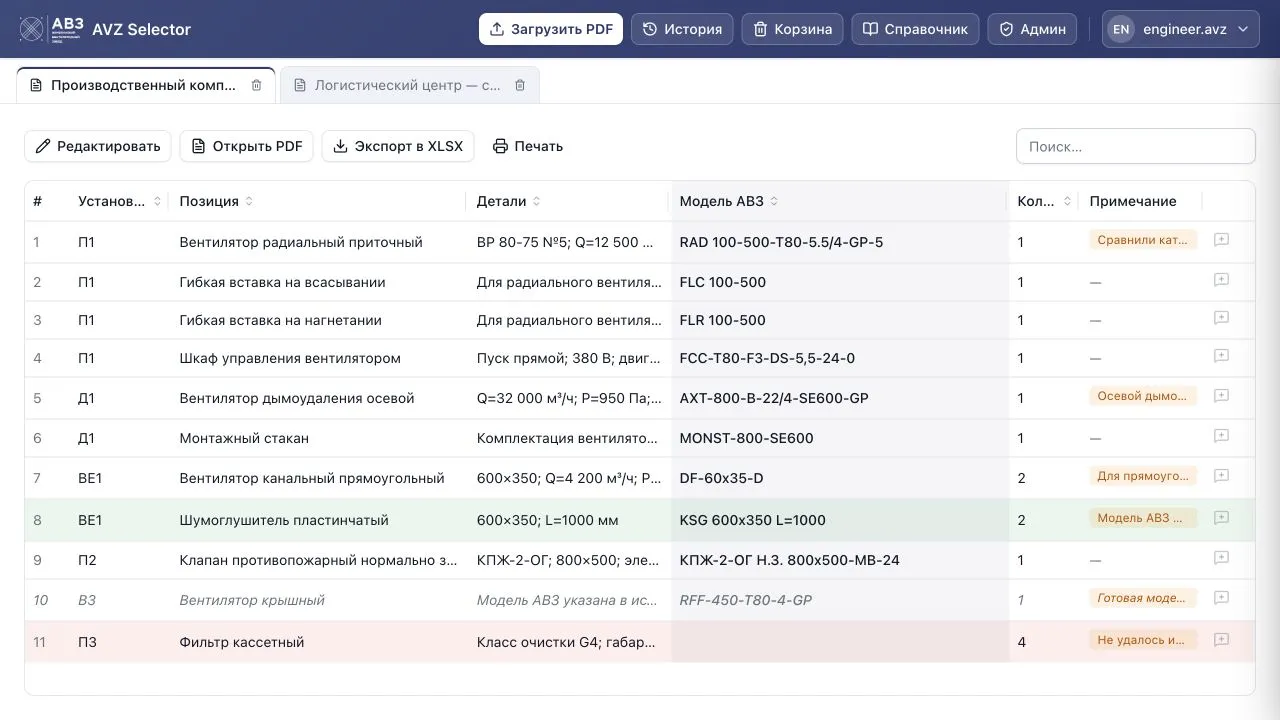
Source data arrives as PDFs with inconsistent tables, notation from different manufacturers, incomplete characteristics and OCR errors. Copying rows into Excel is not enough: the specialist has to determine the purpose of each item, normalise dimensions and flow rates, verify the operating point against technical data, and spot the cases where an automatic answer would be unsafe.
A hybrid AI system: probabilistic models handle the understanding of difficult documents, while formalised domain logic makes the technical decision.
Notation and dimension normalisation, equipment classification, flow and pressure verification, valve actuator sizing, fan model selection and assembly of the related components. Selection relies on digitised catalogues rather than free generation by a language model.
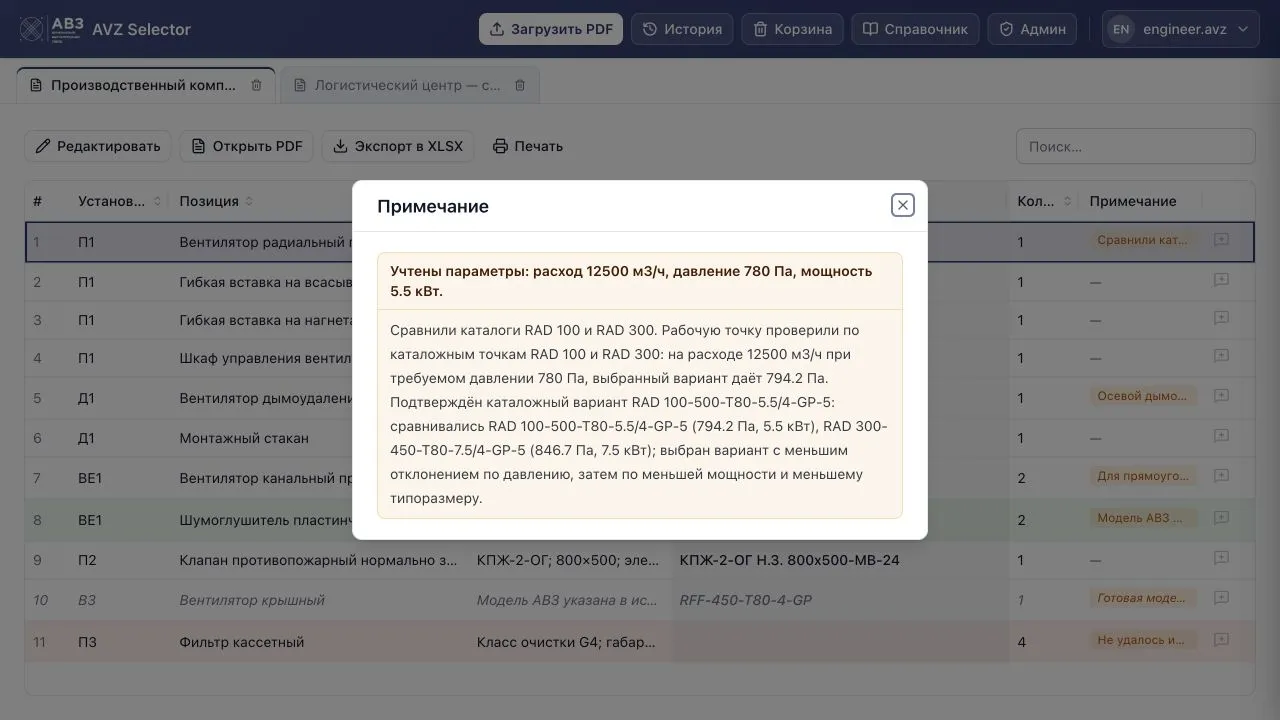
Source parameters, the operating point check, candidate comparison and the ranking rule.
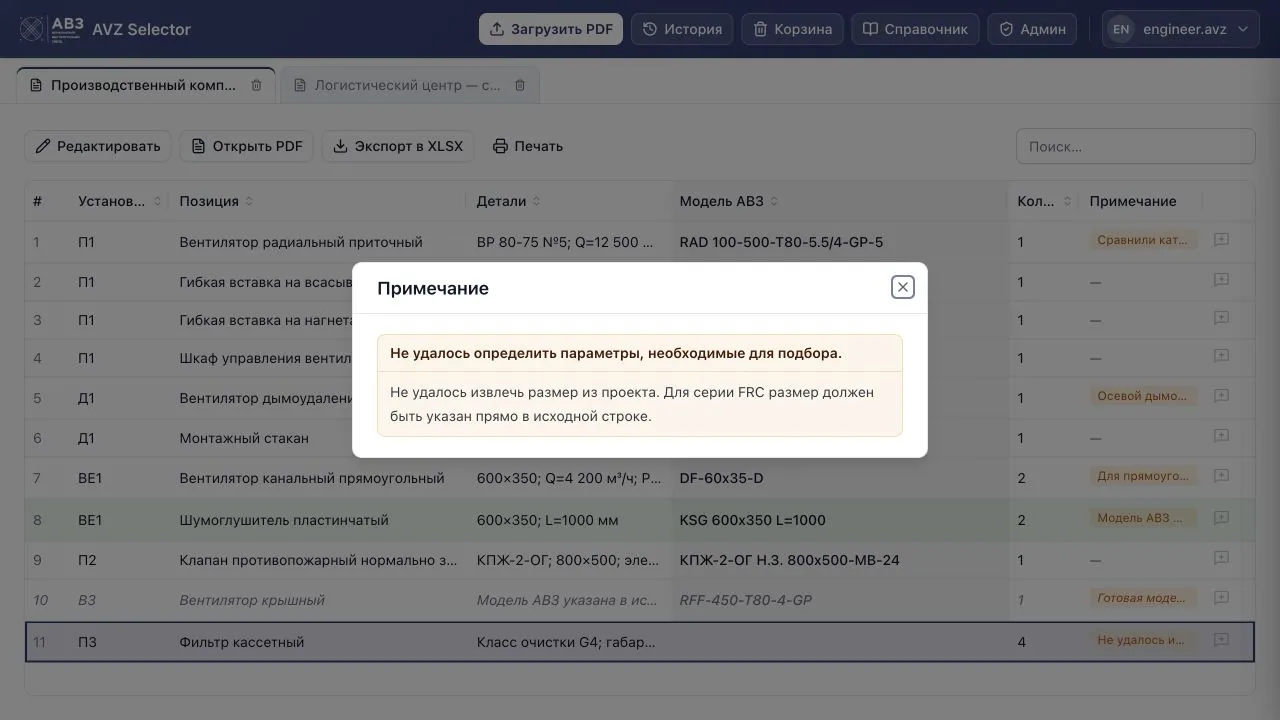
A doubtful item stays in the result with a specific reason for manual review.
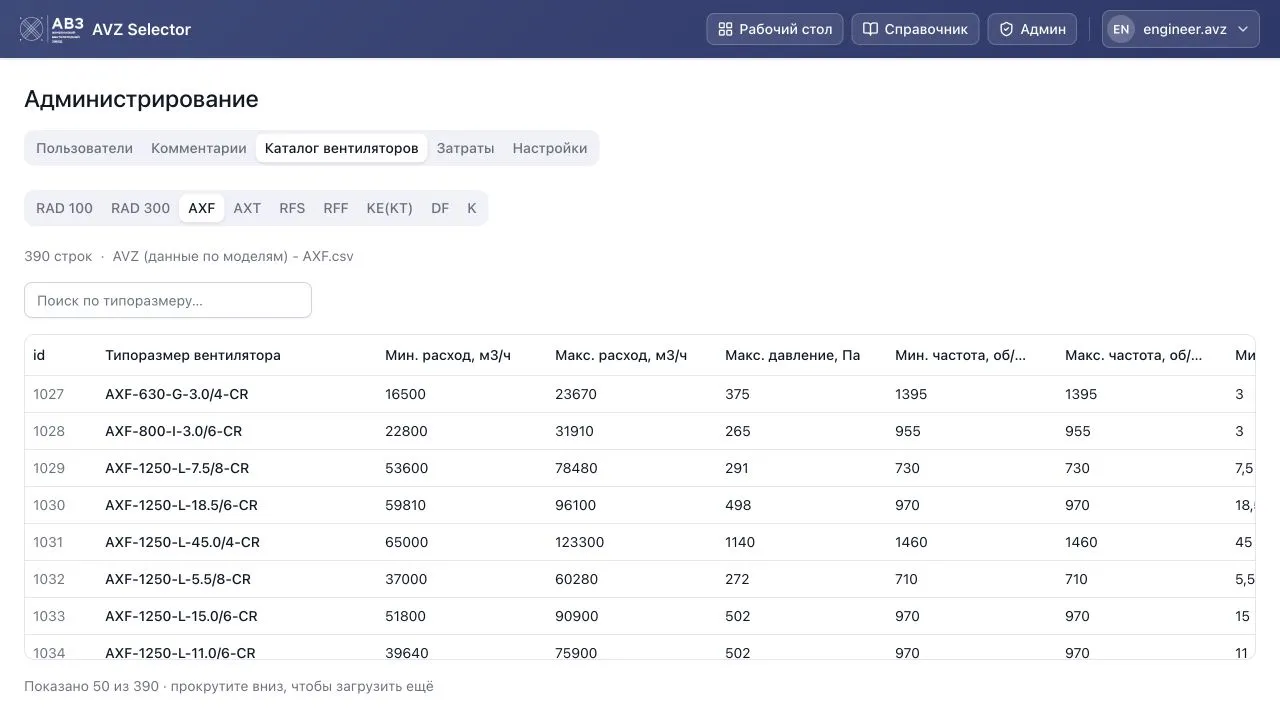
Sizes, operating ranges, pressure, rotation speeds and equipment power ratings.
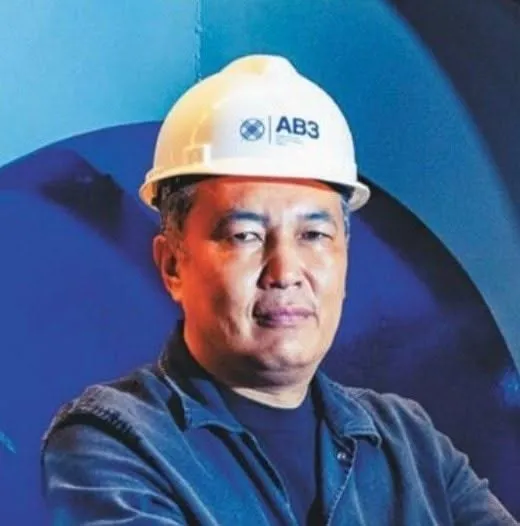
“I set the task myself: selecting equipment from a project specification took our engineers hours, and I could see that artificial intelligence should be doing this work. But an owner’s decision is not enough — without competent specialists a system like this does not appear.
SPECTRA got to grips with the domain at the level of catalogues, operating points and valve actuators, and took the product all the way to industrial use. In parallel the team worked on digitising the plant: modern technology became part of everyday office work rather than a separate project.”
Engineering selection of ventilation equipment from a project PDF specification: Document AI, a catalogue core, explainability and manual control of exceptions.
Read the caseSurveys and interviews in Telegram where the AI runs the open questions: it checks each answer against a completeness criterion, asks follow-ups within a set limit, and extracts a structured summary instead of raw text.
Discuss a taskTakes inbound calls and holds the conversation by voice: consultation, tyre selection, service booking. It acts on the company’s rules and records the outcome in telephony, amoCRM and the calendar — with no waiting on the line.
Discuss a task| № | Stage | What the client gets |
|---|---|---|
| 01 | Process audit | A process map, an assessment of data quality and an honest list of what can be automated now and what has to wait until the data is in order. |
| 02 | Pilot | A working system on one narrow section and a set of regression tests on your real documents. |
| 03 | Rollout | Integration into 1C, ERP and document flow, roles and permissions, staff training, and a procedure for handling exceptions. |
| 04 | Support | Quality monitoring, retraining on feedback, extension to adjacent processes. |
We do not promise an effect in percentages before the audit. The numbers appear after the pilot — on your data.
If your specialists read documentation, check data against catalogues and standards, run routine calculations and assemble the result in spreadsheets by hand — that process can be made faster, more transparent and more scalable.